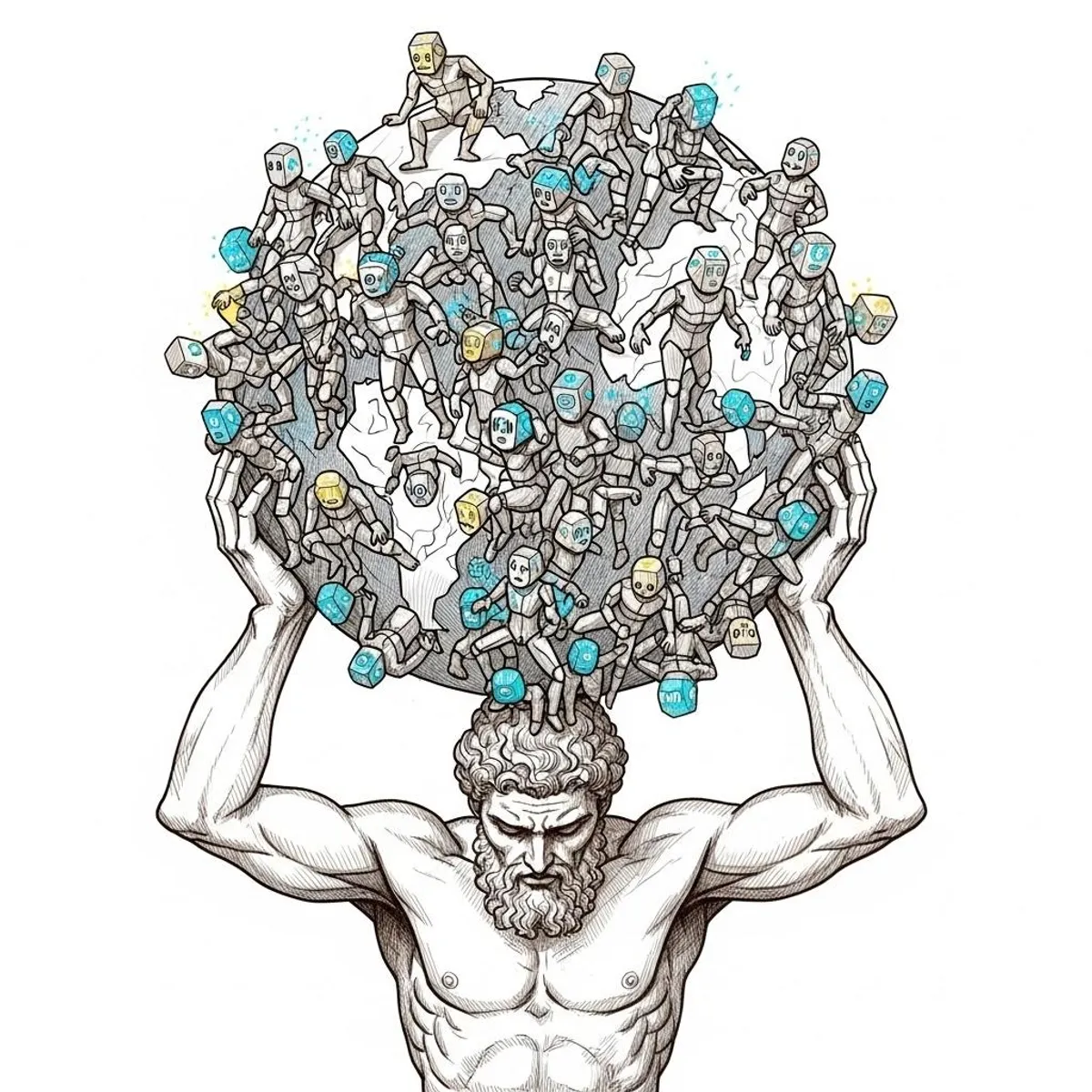
The Atlas Method: 7 AI Agents Inside Copilot (And Why the Architecture Matters More Than the Hack)
Someone built a multi-agent orchestration system for VS Code Copilot with dedicated agent files for each role. The economics are wild, but the architecture patterns are what I can't stop thinking about.
I’ve been building my own multi-agent system for months now. So when I stumbled across the Atlas Method, a framework that orchestrates seven specialized AI agents inside VS Code through GitHub Copilot, I didn’t just see a clever hack. I saw someone solving the same architectural problems I’ve been wrestling with, from a completely different angle.
And honestly? Some of their solutions are better than mine.
What the Atlas Method Actually Is
The Atlas Method (or “Copilot Atlas”) is an open-source GitHub repository containing dedicated .agent.md files for each role in a multi-agent orchestration system. You clone the repo, copy the agent files into your VS Code User prompts directory, and reload. Each file defines a specialized agent with its own model assignment, behavioral rules, and delegation patterns. It builds on copilot-orchestra by ShepAlderson, extending the conductor-delegate pattern with parallel execution and TDD-driven workflows.
Here’s the roster:
- Atlas (
Atlas.agent.md): The orchestrator. Runs on Claude Sonnet 4.5. Delegates everything, executes almost nothing. - Prometheus (
Prometheus.agent.md): The autonomous planner. Runs on GPT 5.2 with high reasoning. Researches requirements, writes TDD-driven implementation plans, and hands off to Atlas for execution. - Oracle (
Oracle-subagent.agent.md): The researcher. Runs on GPT 5.2. Gathers comprehensive context, delegates to Explorer for large-scope research, returns structured findings. - Sisyphus (
Sisyphus-subagent.agent.md): The implementer. Runs on Claude Sonnet 4.5. Follows strict TDD: writes tests first, then minimal code to pass. Can run in parallel for disjoint features. - Code Review (
Code-Review-subagent.agent.md): The reviewer. Runs on GPT 5.2. Returns structured feedback (APPROVED, NEEDS_REVISION, or FAILED) focused on blocking issues. - Frontend Engineer (
Frontend-Engineer-subagent.agent.md): The UI/UX specialist. Runs on Gemini 3 Pro. Handles interfaces, styling, responsive layouts, and accessibility. - Explorer (
Explorer-subagent.agent.md): The scout. Runs on Gemini 3 Flash. Read-only codebase exploration with mandatory parallel search (3-10 simultaneous searches in the first batch).
Seven agents. Seven dedicated files. Each with its own model, scope, and rules of engagement.
And here’s how they fit together:
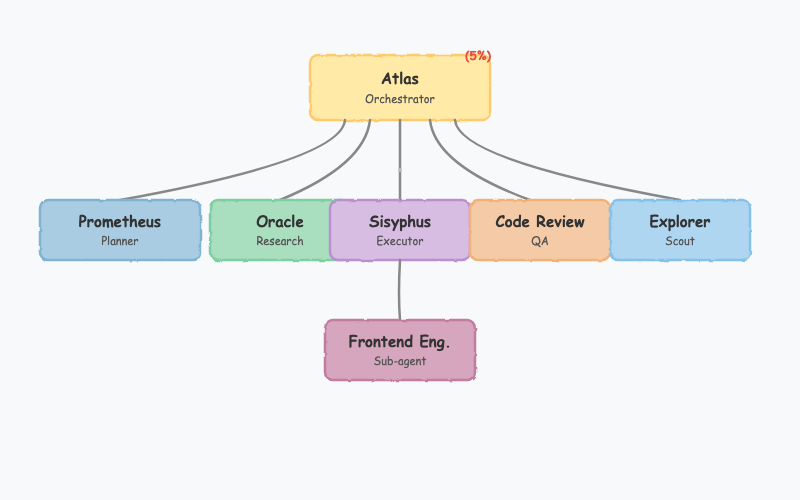
Atlas sits at the top, thin and fast. It routes work to four primary agents (Prometheus plans, Oracle researches, Sisyphus executes, Code Review validates) plus Explorer for codebase scouting. Sisyphus can further delegate UI-specific work to Frontend Engineer. The key: context flows down, and every agent owns exactly one responsibility.
The 5% Principle
Here’s the architectural insight that hit me hardest: Atlas, the orchestrator, uses roughly 5% of the available context window. That’s it. It doesn’t think deeply. It doesn’t hold state. It reads the request, decides which subagent to spawn, and gets out of the way.
The repo’s README calls this “context conservation,” and the numbers back it up. What would take 80-90% of a monolithic agent’s context now takes 10-15%. Researcher agents read and analyze large codebases but return only high-signal summaries. Implementer agents focus solely on the files they’re modifying. Reviewer agents examine only changed files. The conductor orchestrates everything without ever touching the bulk of your codebase.
This is the same pattern I keep arriving at in my own system. The orchestrator’s job isn’t to be smart. It’s to be fast and decisive. The moment your orchestrator starts doing real work, you’ve lost the plot. It becomes a bottleneck instead of a router.
The Atlas Method enforces this through each agent’s .agent.md file, which literally tells the orchestrator: “You do not write code. You do not research. You delegate.” It’s separation of concerns applied to AI agents, and it works for the same reason it works in software architecture. Because bounded responsibilities reduce errors and increase throughput.
The Economics Are Absurd (For Now)
Here’s where it gets spicy. GitHub Copilot’s premium request model charges you per prompt. But subagents spawned within a single prompt don’t count as separate requests. They’re part of the same conversation turn.
So you send one message to Atlas. Atlas spawns Prometheus to plan. Prometheus spawns Sisyphus to execute. Sisyphus spawns Code Review to check the work. That’s four agents doing real work, and you burned one premium request.
Is this a loophole? Absolutely. Will it last? Almost certainly not. GitHub is going to close this gap the moment subagent orchestration starts meaningfully impacting their compute costs. But right now, in February 2026, it works. And the people using it are getting 10x the output per request.
I’m not saying you should build your workflow around a pricing loophole. I’m saying the architecture that makes this loophole possible, orchestrator spawning specialized subagents within a single execution context, is the right architecture regardless of pricing.
The Patterns Worth Stealing
Two patterns from the Atlas Method have stuck with me:
The Refactor Plan Pattern. Before touching any code, Prometheus generates a structured plan with 3-10 incremental, self-contained phases: which files change, in what order, what the expected outcome is for each, plus risk assessments and open questions with recommendations. Sisyphus then executes that plan step by step, following strict TDD (write the test, watch it fail, write minimal code to pass). If the plan is wrong, you catch it before a single file is modified. If the execution drifts from the plan, Code Review catches it.
This is absurdly simple and absurdly effective. Most people (myself included, sometimes) just let the AI start coding and hope it stays coherent. The Atlas Method says: no. Plan first. Execute second. Review third. Every time. And it enforces this through the lifecycle baked into Atlas’s agent file: Planning → Implementation → Review → Commit, repeating until the plan is complete.
The Spec-Driven Workflow. Every task starts with a spec that Oracle helps research and Prometheus formalizes. The spec becomes the contract. Sisyphus codes to the spec. Code Review validates against the spec. If there’s no spec, there’s no work.
I’ve been implementing something similar in my OpenClaw-based system. A research agent that gathers context before a planning agent builds the execution strategy. Seeing the Atlas Method arrive at the same pattern independently tells me this isn’t just one person’s preference. It’s a convergent design. Separating planning from execution is how multi-agent systems need to work.
What I Think This Means
The Atlas Method is a set of agent definition files in a GitHub repo. It’s not a product or a platform. It’s an architecture pattern packaged as installable configuration that turns VS Code Copilot into something it wasn’t explicitly designed to be.
That’s both its genius and its fragility. It works today because Copilot’s agent mode is flexible enough to support subagent delegation through .agent.md files, and because the pricing model hasn’t caught up to the usage pattern. Either of those could change tomorrow.
But the ideas inside it (orchestrator minimalism, plan-then-execute, TDD-driven implementation, parallel execution, specialized agents with bounded roles) those aren’t going anywhere. Those are the patterns that every serious multi-agent system is converging on, whether it’s built inside Copilot, on LangGraph, or on something custom like what I’m doing with OpenClaw.
If you’re building anything with AI agents, study the Atlas Method. Not to copy the agent files, but to understand why it works: a thin orchestrator that routes instead of thinks, specialized agents with their own model assignments and behavioral contracts, parallel execution for independent tasks, and a plan-then-execute-then-review loop that catches drift before it compounds. These aren’t clever tricks. They’re architecture. And architecture outlasts any pricing loophole.
I’m documenting my own multi-agent setup as I build it. Follow along at patrickarobinson.com or check out agent-voices, an open-source framework for giving your AI agents distinct voices.
The Atlas Method was created by u/bigguy345 and shared on r/GithubCopilot. It builds on copilot-orchestra by ShepAlderson.